


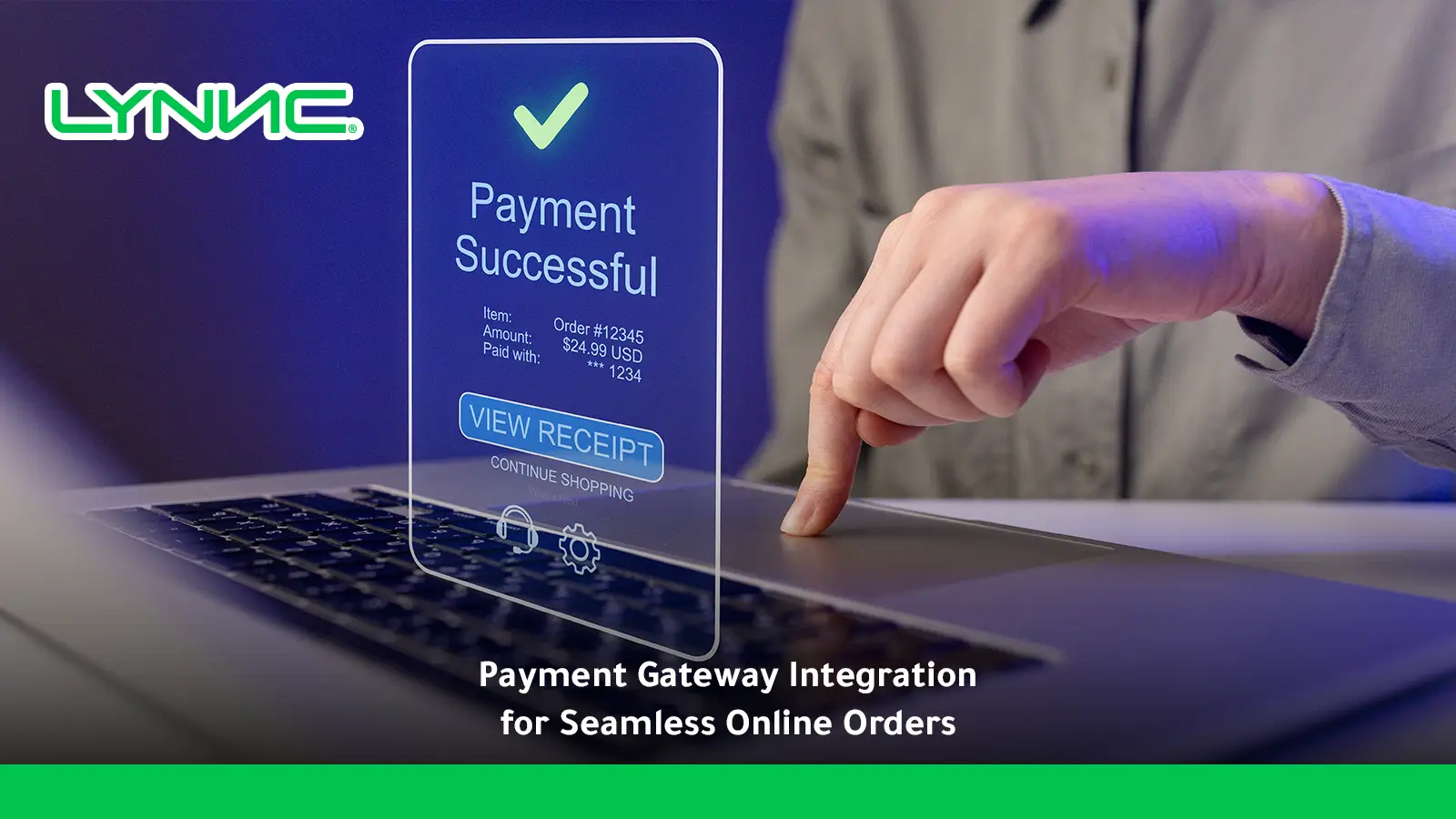
Payment gateway integration for restaurant online stores connects checkout, payment approval, order confirmation, and kitchen operations in one reliable flow. It lets customers pay through methods such as Mada, Apple Pay, and bank cards, while helping restaurants confirm payment before preparation, route valid orders correctly, protect payment data, and reconcile transactions.
restaurant web ordering helps restaurants manage this workflow through a more connected, centralized process.
LYNNC provides a unified environment for managing this workflow more consistently.
The right setup should match local payment habits, mobile checkout expectations, security requirements, settlement terms, and existing restaurant systems.
What Is Payment Gateway Integration?
Payment gateway integration is the connection that allows a restaurant’s online ordering system to securely accept a customer’s payment, receive an approved or declined response, and update the order accordingly.
For restaurant online stores, this connection also determines whether a paid order can move safely from checkout into preparation.
From an operational perspective, payment gateway integration for restaurant online stores acts as a payment checkpoint. Approved transactions can continue into fulfilment, while failed or incomplete payments remain outside the normal kitchen workflow.
From the customer side, the same integration keeps payment inside the ordering journey. Customers can choose available methods such as Mada, Apple Pay, or bank cards without relying on a separate manual payment process.
For the restaurant, this creates a clearer distinction between an order that was submitted and an order that is financially confirmed, reducing unnecessary payment checks before preparation begins.
.webp)
How Restaurant Online Payments Work
Restaurant online payments work by sending the customer’s payment request from checkout through the payment gateway and banking network, then returning an approved or declined result to the restaurant. Once payment is confirmed, the order can move into the restaurant’s operational workflow.
The complete payment journey usually follows five stages:
- Place the order: The customer selects meals, modifiers, delivery or pickup details, and proceeds to checkout.
- Secure the payment request: Payment information is transferred through a protected gateway environment rather than exposing sensitive card details directly to the restaurant’s ordering system.
- Authorise the transaction: The request moves through the relevant payment network and issuing bank, where authentication, available funds, and applicable risk controls are checked.
- Confirm the restaurant order: An approved response changes the order into a paid or confirmed state so it can enter the restaurant workflow.
- Settle the funds: The transaction is later settled according to the gateway, acquiring bank, merchant agreement, and applicable payout schedule.
The operating rule should remain simple: the kitchen acts on a confirmed system status, not on whether a customer says that payment was completed.
Payment Methods Restaurants in Saudi Arabia Should Consider
Restaurants in Saudi Arabia should consider Mada, Apple Pay, and major bank-card networks when building their online payment mix. Together, they cover local card payments, quick mobile-wallet checkout, and customers who prefer international card schemes.
Each method serves a different part of the restaurant’s customer base:
Mada
Payment gateway integration for restaurant online stores in Saudi Arabia should support Mada when the restaurant wants to serve customers using eligible locally issued cards through a familiar domestic payment network.
- Customer fit: Mada gives local customers a payment option that matches established Saudi payment behaviour instead of relying only on international card networks.
- Operational value: Mada transactions can remain inside the same digital order, payment-status, and reconciliation process used for other online payments.
Apple Pay
Payment gateway integration for restaurant online stores can use Apple Pay to reduce mobile checkout effort for eligible customers, allowing payment to be approved through the customer’s device without repeatedly entering complete card information.
- Customer fit: Fewer checkout actions can make ordering more convenient for customers placing quick food orders from a mobile device.
- Trust benefit: Familiar wallet authentication can make customers more comfortable completing a transaction without manually typing card details into the restaurant website.
Bank Cards
Payment gateway integration for restaurant online stores should also support relevant bank-card networks such as Visa and Mastercard to serve customers who do not use Mada or a digital wallet.
- Customer fit: Bank cards widen payment coverage for visitors, international customers, and customers using non-local cards.
- Checkout value: Offering cards alongside Mada and Apple Pay prevents the restaurant from making one payment method the only route to completing an online order.
Payment Gateway vs Payment Processor
A payment gateway securely captures and transfers payment information from the restaurant checkout, while a payment processor handles the financial communication required to route and authorise the transaction between payment networks and banks.
The practical difference becomes clearer when both roles are compared side by side:
Restaurants mainly interact with the gateway experience during implementation, but processing and acquiring arrangements still influence approval, settlement, and the final financial result.
Security Requirements for Restaurant Payments
Restaurant payment security should protect card information throughout checkout while reducing the amount of sensitive payment data stored or handled directly by the restaurant. A secure integration combines payment-industry controls, encryption, authentication, fraud monitoring, and platform security.
The main controls to review include:
- PCI DSS controls: Payment gateway integration for restaurant online stores should minimise direct exposure to raw card data and use payment infrastructure designed around recognised card-data security requirements.
- TLS encryption: Information travelling between the customer, restaurant website, and payment services should use encrypted connections.
- 3D Secure: Where required, customer authentication should work without leaving the restaurant uncertain about whether the transaction succeeded.
- Tokenisation: Sensitive card information can be replaced with payment tokens so reusable card numbers do not need to remain inside the restaurant’s own database.
- Fraud controls: The selected gateway should provide tools for detecting suspicious transactions before fraudulent orders become an operational problem.
- Access and platform security: Ordering platforms, plugins, APIs, administrator accounts, and connected systems should remain updated and appropriately restricted.
How Payment Integration Connects With Online Ordering
Payment integration connects an approved transaction with order confirmation, kitchen routing, order status, fulfilment, and financial reconciliation. Instead of treating payment as the end of checkout, the restaurant uses it as the event that moves a valid order into operations. For table-side experiences, compare the integration requirements and guest journey for QR payments for restaurants.
That connection normally affects the following parts of the order journey:
- Order confirmation: A successful transaction moves the order from awaiting payment to confirmed, helping prevent unpaid orders from entering preparation by mistake.
- Kitchen routing: Confirmed orders can move into the POS, kitchen printer, or Kitchen Display System according to the restaurant’s configured workflow.
- Order status: Customers can receive updates when an order is confirmed, being prepared, ready, or entering delivery.
- Inventory and availability: Connected systems can use confirmed orders to support availability and inventory decisions instead of relying on a separate sales record.
- Delivery coordination: Payment and order status can connect with the fulfilment process so dispatch is triggered from a valid confirmed order.
- Financial reconciliation: Payment references should remain connected with order IDs, making it easier to compare sales, refunds, settlements, and individual orders.
The goal is to keep payment and operations inside one traceable order journey rather than forcing staff to confirm transactions and orders across separate systems.
Common Payment Gateway Integration Problems
The most common payment gateway integration problems are checkout timeouts, missing payment confirmations, duplicate transactions, mobile checkout issues, authentication failures, and broken hand-offs between payment and restaurant operations.
Restaurants should monitor these failure points closely:
- Checkout timeouts: The customer waits for a response while the restaurant cannot determine whether the transaction completed, creating uncertainty and possible duplicate attempts.
- Webhook failures: Payment succeeds, but the confirmation does not reach the ordering system, leaving a paid customer without a confirmed restaurant order.
- Duplicate transactions or orders: Poor retry logic can submit a request again when the customer refreshes the page or when an earlier response arrives late.
- Mobile checkout friction: Slow pages, redirects, small input fields, or unnecessary steps can make payment difficult on mobile devices.
- Unclear error messages: A generic “payment failed” message does not tell the customer whether to retry, change the card, or take another action.
- Authentication failures: Problems during 3D Secure or bank authentication can interrupt otherwise valid payments.
- API changes: Gateway APIs, plugins, and authentication requirements can change, so payment integration requires ongoing maintenance.
- Broken kitchen hand-off: A payment may succeed while POS or KDS routing fails, which means financial success and operational order success should be monitored separately.
What to Check Before Choosing a Payment Gateway
Review supported restaurant system integrations to confirm the applicable POS, ordering and payment workflow before launch.
- Local payment support: Payment gateway integration for restaurant online stores in Saudi Arabia should support payment methods relevant to the restaurant’s customers, including Mada, Apple Pay, and appropriate bank cards.
- Full pricing structure: Review setup costs, transaction fees, recurring charges, refund fees, chargebacks, and other costs that may apply.
- Integration compatibility: Confirm that the gateway works with the restaurant website, POS, ordering system, APIs, and operational workflow.
- Settlement terms: Check how payouts work, what can delay settlement, and how transactions appear in financial reporting.
- Mobile checkout quality: Test payment on real mobile devices, including authentication, redirects, failed-payment recovery, and the return to order confirmation.
- Webhook reliability: The gateway should provide a reliable way to confirm transaction status even when the customer closes the browser before returning to the restaurant website.
- Security controls: Review PCI responsibilities, tokenisation, authentication, fraud-management tools, credential protection, and access controls.
- Refund workflow: Staff should understand how full and partial refunds are processed and how they remain linked with the original restaurant order.
- Technical support: Review how payment incidents are reported, escalated, and resolved because payment problems directly affect the ability to complete online sales.
- Reporting and reconciliation: Transaction IDs, payment status, refunds, and settlements should be easy to match against individual restaurant orders.
Build Payment Around the Restaurant Workflow, Not Just Checkout
Payment gateway integration for restaurant online stores works best when payment approval becomes one reliable event inside the complete order journey. The restaurant should be able to see whether payment succeeded, whether the order reached operations, and whether the transaction can later be reconciled without comparing disconnected systems manually.
This makes payment part of restaurant operations rather than a standalone website feature. LYNNC’s restaurant system software can centralise order management and real-time order tracking, helping restaurants maintain visibility after the customer completes checkout.
The right gateway is therefore not simply the one with the longest list of features. It is the option that fits the restaurant’s customer payment habits, existing technology, operational workflow, security requirements, and support needs.
Ready to connect payment with the full ordering journey? Restaurants building a direct digital sales channel can explore LYNNC’s Online Ordering Store to connect online ordering with the wider restaurant workflow rather than treating checkout as a separate customer experience.
Payment Gateway Integration for Restaurant Online Stores: Common GCC Questions
What payment options are essential for converting web store visitors in the GCC?
Restaurants in Saudi Arabia should offer Mada, Apple Pay, and major bank-card schemes. This gives customers familiar local and international payment options while reducing unnecessary friction during checkout.
Does a restaurant need both a payment gateway and a payment processor?
Yes. The gateway securely captures and transfers payment information, while the processor routes the transaction between banks and payment networks. Some providers combine both functions within one service.
Should the kitchen receive an order before payment is confirmed?
No, not for prepaid orders. The kitchen should receive the order only after payment is confirmed. Cash-on-delivery and pay-at-pickup orders should follow separate rules so staff can clearly identify unpaid orders.
How does a payment gateway build customer trust?
It builds trust by offering familiar payment methods, secure authentication, clear transaction status, smooth mobile checkout, and understandable error messages. Customers should always know whether they were charged and whether their order was received.
What should restaurants test before launching online payments?
Restaurants should test successful and declined payments, authentication, slow connections, duplicate attempts, refunds, mobile checkout, webhook failures, and kitchen routing. A payment flow is not complete unless both the transaction and the restaurant order are confirmed correctly.
learn more about daily Specials for Restaurant Online Orders: Drive Repeat Sales

