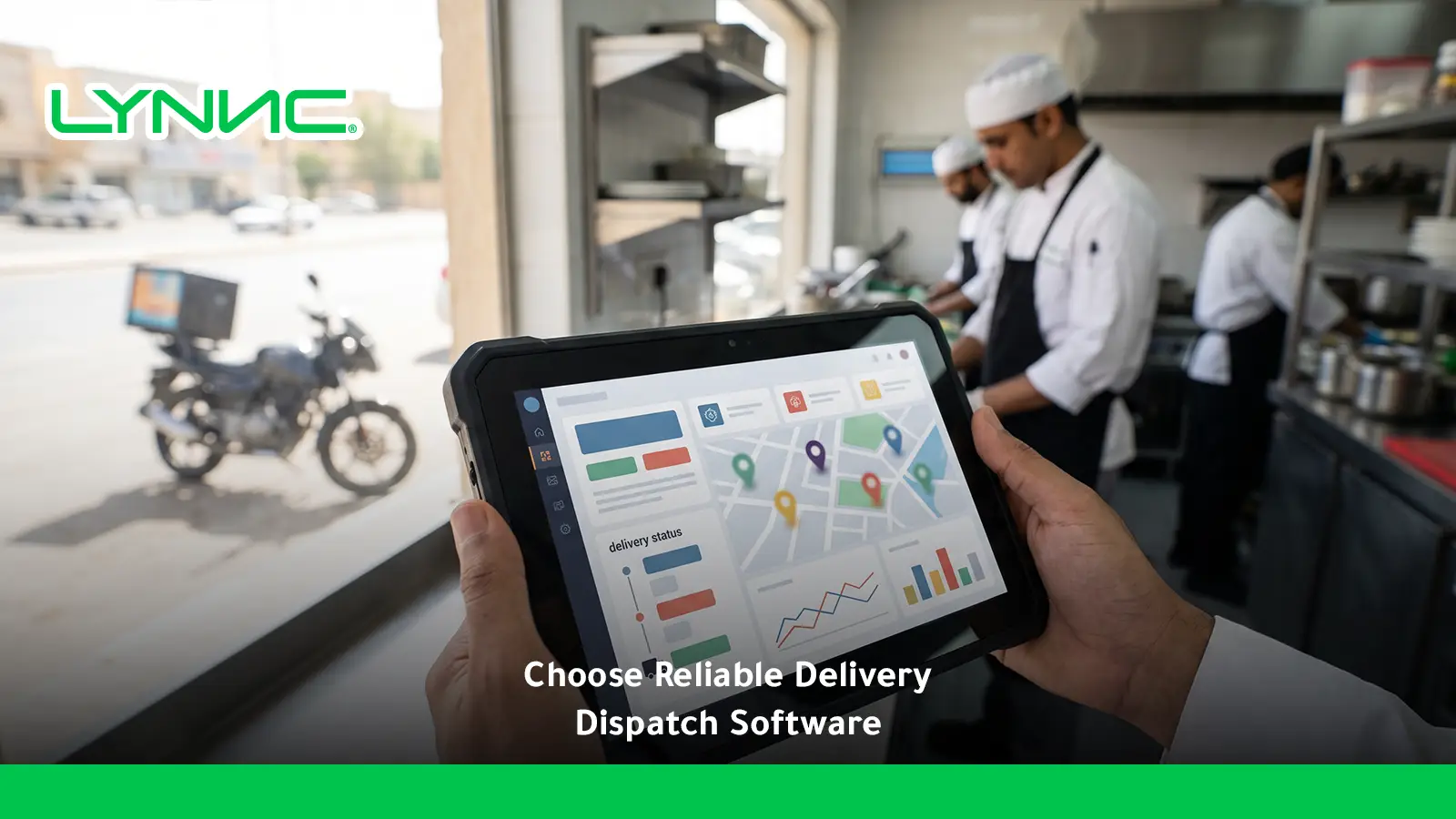
Restaurant fleets lose delivery visibility when kitchen readiness, driver assignment, pickup, and customer handoff are recorded in separate systems or updated late. Effective last mile delivery requires one order reference, verified handoff events, realistic ETA updates, an accountable dispatcher, and clear exception escalation. Map each event to its owner and evidence, then test delays and failed handoffs before scaling across Saudi branches. Tracking alone cannot confirm successful delivery in practice.
This guide focuses on documenting the owner and accepted evidence for each delivery event, including the original delivery promise and revised ETA. The broader last-mile operations guide covers the fulfillment model; use the dispatch guide for assignment rules.
The problem — restaurant fleet delays obscuring handoff and order status
Delays become difficult to resolve when the kitchen marks an order ready, dispatch assumes a driver collected it, and the customer's screen says “on the way” even though the meal is still at the counter. For last mile delivery, the problem is not simply vehicle speed: it is missing evidence about who holds the order and what must happen next.
To recognize this breakdown, look for the following symptoms and causes:
Symptoms visible to restaurant operations
- Ready but not collected: The kitchen has finished, but the branch cannot confirm a physical pickup.
- Assigned but not accepted: A name appears against the task, yet no driver has acknowledged it.
- Moving dot, unchanged order: GPS changes while the order status remains stale or incorrect.
- Unexplained delivery completion: The driver is near the destination, but no valid handoff evidence exists.
Root causes that require different fixes
Kitchen, order, and fleet systems own different records
The POS handles sales and kitchen tickets; an order management system (OMS) coordinates order status; a fleet system handles delivery tasks and driver events. Without a shared order reference and documented ownership, each screen can tell a different story.
Estimated arrival uses an incomplete clock
A driving estimate alone excludes remaining preparation, assignment delay, travel to pickup, and handoff time. An ETA becomes misleading when those stages are omitted or old driver positions are treated as live.
Exceptions have no named owner
An unaccepted assignment, broken-down vehicle, inaccessible address, or failed customer handoff can remain “in progress” indefinitely unless a dispatcher has a clear escalation rule.
How to diagnose the failure and capture evidence
Investigate one delayed order before comparing entire branches. Identify its last verified event, the system that recorded it, and the next event that should have occurred. Use the following sequence when last mile delivery status becomes unclear:
1. Trace one order from kitchen readiness to customer receipt
- Match the original order ID to the branch, POS ticket, and delivery task ID.
- Record timestamps for kitchen-ready, driver assignment, acceptance, arrival at branch, actual pickup, and customer handoff.
- Label missing events as unverified, not as completed because a later screen changed.
Example: The task says “assigned” at 7:20 p.m., but the driver never accepted it. The first fix is assignment ownership, not a revised route.
2. Separate location evidence from handoff evidence
Verify driver availability and freshness
Check whether the driver's last location is recent, whether the driver is already working on another task, and whether the reported position is genuinely usable for dispatch. A stale GPS point is not proof of current availability.
Verify food custody and completion
At pickup, confirm the order and package count against an actual transfer. At delivery, use the restaurant's agreed proof-of-delivery procedure; reaching an address is not proof that the guest received the food.
3. Keep a short investigation record
Capture order ID, branch, task ID, last confirmed event, its timestamp and source, original and revised ETA, exception reason, current owner, and next action. Restrict unnecessary personal or location information to authorized staff.
Step-by-step solution — map handoff, ETA, driver assignment and delivery exceptions
A reliable last mile delivery process joins four controls: physical handoff, feasible assignment, a changing ETA, and documented exception decisions. Apply the steps below in order so employees do not mistake a software status for an action that never happened.
Step 1. Agree on the authoritative event for every stage
At the kitchen counter
- Ready: The kitchen confirms that the packed order is available for collection.
- Collected: Staff or an approved check-in process records that the correct driver took the correct packages.
- Not collected: Keep the order in a waiting state and give a supervisor ownership of the delay.
An order marked ready must not automatically become “picked up” merely because a driver has been assigned.
Step 2. Assign a driver who can meet the pickup window
- Check actual availability, coverage area, current tasks, capacity, and estimated arrival at the branch.
- Require assignment acceptance or another documented confirmation appropriate to the fleet's operating model.
- Return rejected or expired tasks to a monitored exception queue; do not silently assume another driver accepted.
Example: Driver A is closer but still carrying two orders. Driver B is farther away but can arrive when the kitchen finishes. Compare feasible pickup timing, not distance alone.
Step 3. Set an ETA based on remaining work
Use kitchen readiness, driver travel to pickup, collection time, road travel, and customer handoff when constructing the expected delivery window. Traffic-aware routing can inform travel duration, but its result is an estimate rather than a guaranteed arrival time.
When should an ETA change?
- Recalculate when actual pickup is later than planned, a route becomes blocked, or another material delay occurs.
- Share a revised window only through a customer channel supported and approved for the restaurant.
- Mark the estimate as uncertain if driver tracking or operational events are stale.
Step 4. Assign one owner to each delivery exception
- Driver rejects: Dispatch supervisor checks available replacements and records the next accepted task.
- Driver breaks down after pickup: Confirm food custody and safety; close or control the old task before authorizing a replacement.
- Customer cannot be reached: Follow the approved contact and failed-delivery procedure rather than marking the task delivered.
- Food cannot be safely delivered: Refer the decision to the authorized branch or food-safety lead.
Step 5. Reconcile systems and close the order once
Compare the OMS order, fleet task, POS record, and the final handoff evidence. Resolve duplicate or out-of-order updates against the original order ID; do not create a fresh customer order merely to repair a dispatch error. This is especially important where integrations retry events after timeouts.
Last-mile restaurant operations map
A last mile delivery operations map is not merely a GPS display. It shows the ordered business events, who owns them, what proves each event occurred, and where an unresolved task must go. Use this model to document responsibilities across branches:
| Stage | System of record or evidence | Accountable role | Accepted evidence | If the event fails |
|---|---|---|---|---|
| Order accepted | OMS/order channel | Order operations | Original order ID and branch | Resolve routing or invalid branch |
| Kitchen ready | Kitchen/POS workflow | Kitchen lead | Time-stamped preparation completion | Escalate unfinished meal |
| Driver assigned and accepted | Fleet task record | Dispatcher | Accepted task and driver ID | Reassign only with controlled ownership |
| Driver arrives at branch | Verified driver event | Dispatcher/branch | Time-stamped arrival/check-in | Investigate pickup waiting |
| Food picked up | Physical handoff record | Branch handoff lead | Order ID, package count, pickup time | Hold task; confirm food custody |
| In transit and ETA revised | Fleet tracking plus events | Dispatch supervisor | Fresh tracking and approved ETA version | Investigate stale data or delay |
| Delivered or failed | Customer handoff/exception record | Driver and service owner | Required proof or documented failure | Escalate dispute, return, or safe replacement |
| Reconciled and closed | OMS and operations review | Operations manager | One final outcome linked to order ID | Keep an exception open until resolved |
Model the normal path and exception path separately
- Order accepted → Kitchen ready → Driver accepts task.
- Physical pickup.
- In transit with updated ETA.
- Delivered or failed attempt.
- Reconcile final order status.
If an event is missing: assign a named exception owner; verify custody and the last event; recover, reassign or escalate; record one final outcome.
This map is a recommended operating design, not a diagram of LYNNC's internal architecture. Keep the POS's sales record separate from OMS status and fleet assignment; the integrations between them must be verified in the deployed configuration.
Saudi restaurant operations scenario
HYPOTHETICAL — not a documented customer result. A six-branch restaurant group in Riyadh runs its own drivers. A dinner order is accepted at 7:05 p.m., marked ready at 7:19, assigned at 7:22, and physically collected at 7:27. The original customer arrival estimate was 7:48, but traffic disruption requires a revision to 8:01. Delivery is confirmed at 8:04.
First: identify the actual handoff delay
This last mile delivery case shows that the food waited eight minutes between kitchen readiness and pickup. Three minutes passed between readiness and assignment; the remaining five minutes passed before actual pickup. Without separate timestamps, management might incorrectly attribute all eight minutes to traffic.
Next: revise the customer commitment responsibly
The dispatch supervisor records the route disruption and revises ETA only after confirming the driver and task are still active. If customer notifications are configured and supported, the new estimate is communicated without promising an exact guaranteed arrival.
Finally: measure the outcome and assign improvement work
Pickup Waiting Time = Actual Pickup Time - Kitchen Ready Time = 8 minutes
Delivery Lateness = Actual Delivery Time - Original Promised Time = 16 minutes
Revised ETA Absolute Error = |Actual Arrival - Revised ETA| = 3 minutes
These illustrative values reveal different issues: handoff waiting, a missed original promise, and the accuracy of a revised prediction. They do not represent a performance claim about LYNNC or Riyadh traffic.
What to validate in a vendor demo
Use one representative order and one failure case to compare vendors. The main purchase question for last mile delivery is whether the chosen setup preserves verified handoffs and accountable exceptions with the restaurant's actual POS, OMS, and driver fleet.
| Option | Where it can work | What remains the restaurant's responsibility |
|---|---|---|
| Manual dispatch with a shared incident log | Smaller fleet and controlled order volume | Staff must update events and reconcile mistakes |
| Dedicated fleet platform | Restaurant-managed drivers across branches | Verify real integrations, event ownership, and licensed features |
| Third-party delivery partner | Outsourced final-mile execution | Partner controls courier assignment; restaurant needs contractual status and escalation access |
| Mixed in-house and partner model | Different delivery zones or peak overflow | Separate task ownership, customer promises, and reporting by route |
Demonstration tests to request
Use the same last mile delivery test order throughout the demo so results can be compared.
- Kitchen-ready handoff: Show the difference between ready, assigned, driver arrived, and physically picked up.
- Assignment failure: Reject a task and show who is alerted and what prevents two active assignments.
- Stale driver location: Disconnect the driver and verify that old GPS is not presented as a current position.
- ETA revision: Introduce a route delay and show the revised estimate and permitted customer communication.
- Delivery dispute: Simulate arrival without valid proof of handoff, and inspect the exception record.
- Multi-branch operation: Repeat the flow for a second Saudi branch with its own pickup and delivery zone.
Where LYNNC fits and when to request a demo
LYNNC Fleet Management documents live fleet visibility, route planning, driver performance indicators, and a connection to supported Order Management workflows for restaurant-managed drivers. It does not mean the restaurant controls couriers employed by outside delivery apps, and automatic dispatch, proof-of-delivery methods, or customer alerts require confirmation for the proposed configuration.
For the broader delivery operating model, read Last-Mile Delivery for Saudi Restaurants. For assignment-specific decisions, the delivery dispatch and exceptions guide provides additional context. Request a demo using one of your branch's delayed orders rather than a generic ideal delivery.
KPIs and implementation acceptance tests
Measure the gaps between confirmed events, not just the number of delivered orders. In last mile delivery, a fast average can hide unaccepted jobs, slow kitchen pickup, stale ETAs, and unresolved customer handoffs.
Operational metrics
| KPI | Definition | Action when it deteriorates |
|---|---|---|
| On-time delivery rate | Completed deliveries within the agreed promise / eligible completed deliveries | Segment by branch, zone, and service period |
| Assignment delay | Accepted assignment time minus ready-for-dispatch time | Review available driver capacity and task acceptance |
| Kitchen pickup wait | Physical pickup time minus kitchen-ready time | Separate kitchen and courier handoff issues |
| ETA absolute error | Absolute difference between predicted and actual arrival | Review input freshness and traffic assumptions |
| Unowned exception count | Open exceptions without a named responder | Escalate immediately to the shift manager |
| Duplicate active delivery tasks | More than one unauthorized active task for one order | Stop further dispatch and reconcile task ownership |
| Confirmed handoff coverage | Deliveries with required proof / eligible completed deliveries | Investigate missing completion evidence |
On-Time Delivery Rate = (On-Time Eligible Deliveries / Total Eligible Completed Deliveries) × 100
HYPOTHETICAL calculation: If 46 of 50 eligible completed deliveries meet the restaurant's defined promise, the rate is 46 / 50 × 100 = 92%. It is a training example, not a sector benchmark or LYNNC result.
Quality-assurance checklist and go/no-go decision
- A single order reference links the branch, POS, OMS, and fleet task.
- Ready, assigned, accepted, arrived, picked up, and delivered are distinct verified events.
- An unaccepted or rejected assignment has a named owner and escalation path.
- Outdated driver locations cannot silently confirm pickup or delivery.
- ETA is reviewed after a material change; customer messaging is validated for the selected channel.
- The system does not create an unintended second active delivery on event retry.
- Failed attempts and proof-of-delivery gaps remain visible until resolved.
- The same tests pass for representative Saudi branches and devices.
Go: Every critical event has a verifiable owner, a correct order reference, and a recoverable exception path. No-go: Food custody is unknown, duplicate tasks remain active, a failed delivery is incorrectly marked completed, or the vendor cannot demonstrate required integration behavior.
Frequently Asked Questions
Why do restaurant fleet delays obscure handoff and order status?
Kitchen, POS, OMS, and fleet systems can update at different times and may not share a verified pickup event. That hides whether the food is still waiting, with a driver, or actually delivered. Connect events to one order ID and assign an owner to each missing transition.
How can an operator map handoff, ETA, driver assignment and delivery exceptions?
List the stages from kitchen-ready through verified delivery, and specify the source, timestamp, responsible role, and acceptable evidence for each. Then define what happens when an assignment is refused, GPS goes stale, or the customer cannot receive the food. Test the recovery path before opening it to all branches.
What should a Saudi restaurant verify during a software demo?
Require an end-to-end demonstration using the restaurant's supported POS and fleet configuration, including assignment acceptance, physical pickup, ETA changes, and a failed delivery. Confirm which features are included, which depend on configuration, and whether external delivery-app couriers remain under another company's control.
Which operational metrics show whether delivery handoffs are reliable?
No single metric proves that every handoff is reliable. Monitor on-time delivery alongside assignment delay, pickup wait, ETA error, duplicate tasks, and exceptions without owners. A successful rollout also needs verifiable delivery outcomes and no unresolved critical test failures.
Decision summary and next step
For a last mile delivery purchase decision, ask whether the solution makes the last verified event, responsible person, and next action unmistakable. Explore LYNNC Fleet Management and request a scenario-based demonstration for your branches; integration scope and promised SLAs should be confirmed rather than assumed.