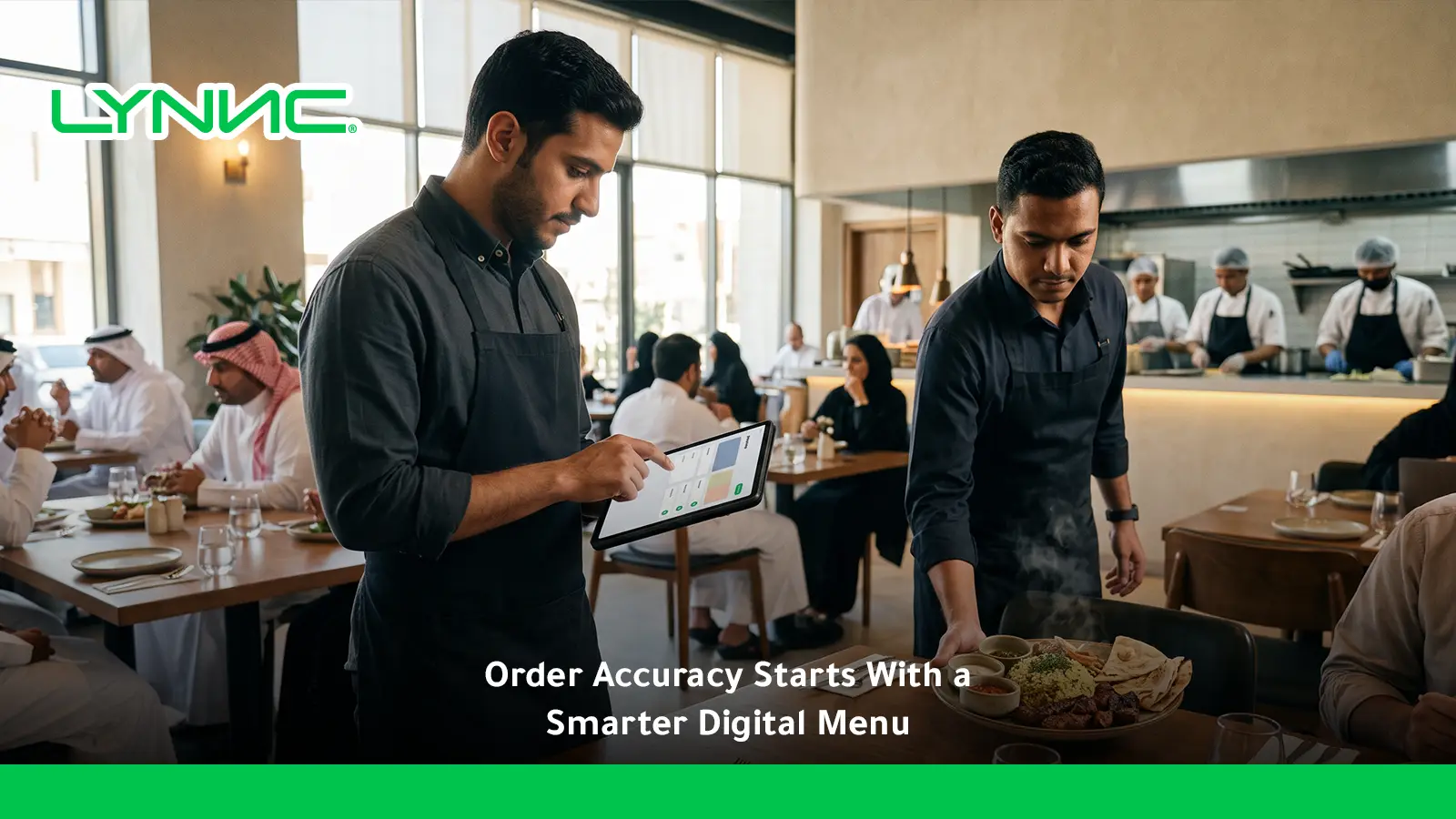
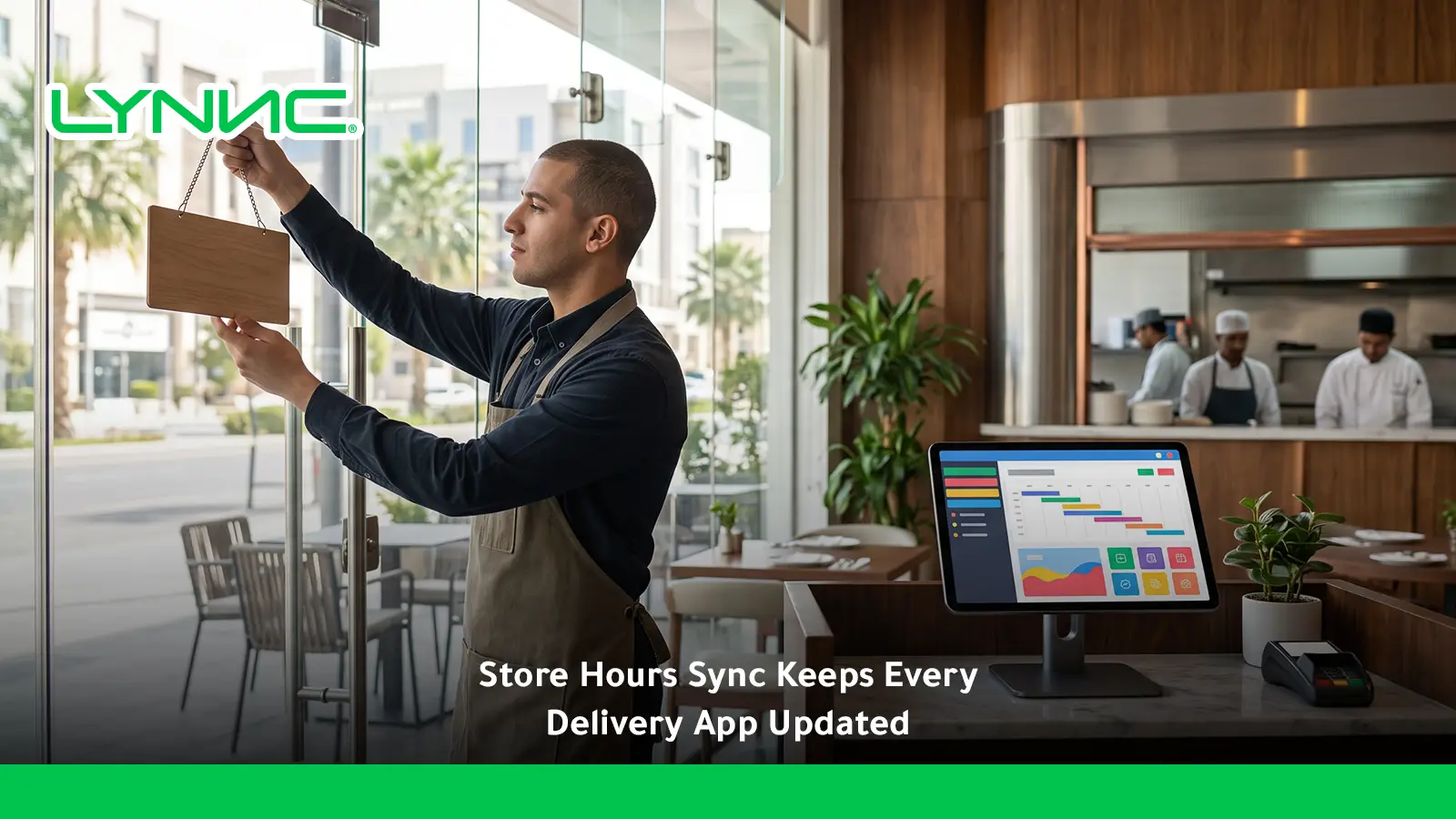
A restaurant management system in Saudi Arabia connects point-of-sale transactions, digital orders, menus, kitchen preparation, delivery, and branch reporting through coordinated software and integrations. The POS records sales and payments, while order management coordinates incoming channels and fulfillment. For multi-branch restaurants, reliable connections keep orders, product availability, branch assignments, and operational data consistent. This guide explains the essential components, integration workflows, system comparisons, Saudi requirements, implementation steps, and where LYNNC fits.
What a restaurant management system includes
A restaurant management system (RMS) is the combination of software and processes used to manage restaurant transactions, ordering, fulfillment, menus, branches, and business performance. Depending on the provider, these functions may exist within one application or operate through several connected platforms.
Understanding the main components helps restaurant operators identify what their current technology already handles and where additional integrations are needed. The essential components include:
1. Sales and transaction management
Point-of-sale transactions: The restaurant POS records purchases, items, quantities, discounts, applicable taxes, and transaction references. These records provide the financial foundation for daily sales and transaction reporting.
Payment recording: The POS and connected payment services handle the relevant payment workflow, including payment status and reconciliation information. A separate order management layer should not automatically be treated as a replacement for these functions.
Transaction consistency: When digital orders enter through several channels, their product identifiers, prices, discounts, and payment information must be transferred correctly into the responsible transaction system.
2. Order coordination and fulfillment
Centralized order intake: Order management software brings supported orders from delivery applications, websites, QR ordering, and other digital channels into a coordinated operating environment, reducing the need to monitor each source separately.
Order lifecycle visibility: Restaurant teams can follow relevant stages such as received, accepted, preparing, ready, and completed. Each stage must have a clearly defined meaning so employees and connected platforms interpret updates consistently.
Fulfillment coordination: Orders must reach the correct branch and preparation workflow while preserving customer selections, item modifiers, special instructions, and the intended fulfillment method.
3. Menu, product, and availability management
Structured menu records: Products, variations, modifiers, descriptions, prices, and availability settings need stable identifiers so connected applications refer to the same items, even when customer-facing names differ.
Channel-specific settings: Restaurants may need different menu visibility, pricing rules, or operating hours across delivery applications and direct ordering channels. These differences should be intentional rather than caused by outdated information.
Availability control: A restaurant should be able to reflect when an item is no longer available at a particular branch, subject to the capabilities of the connected systems and ordering channels.
4. Branch coordination and operational reporting
Branch-level operations: Multi-branch restaurants need to maintain correct location identifiers, service hours, menus, and order assignments while preserving central management visibility. For order-specific scaling challenges, see multi branch restaurant management for orders.
Operational reporting: Managers need consistent information about order volumes, cancellations, preparation delays, channel activity, and branch performance rather than disconnected reports from individual systems. A practical framework for comparing locations is covered in restaurant reporting for branch performance.
Management accountability: Restaurant headquarters should be able to identify which branch, ordering channel, or operational process requires attention without confusing one location's results with another's.
For restaurant groups managing several digital channels, the (LYNNC restaurant operations platform) provides a connected environment for order management, supported integrations, menu operations, and branch visibility.
The difference between POS, OMS and integrations
The main difference is responsibility: POS handles restaurant transactions, an order management system (OMS) coordinates orders, and integrations allow information to move between applications. A broader RMS connects these responsibilities into an operating model that supports the restaurant from order acceptance through fulfillment and reporting.
1. What the POS should control
Sales accuracy: The POS records the transaction according to the restaurant's configuration, including items, taxes, discounts, totals, and payment information where applicable.
Financial accountability: Refunds, transaction adjustments, and payment reconciliation should remain within the responsible financial and POS processes, even when an external OMS coordinates the original order.
Operational connectivity: A POS may include kitchen, inventory, and digital ordering capabilities or provide them through integrations. The actual scope depends on the product, edition, and connected modules. For the system-level connection between POS and ordering workflows, review integrated POS system for restaurant ordering.
2. What order management software should control
Cross-channel order intake: The OMS receives and coordinates eligible orders from supported digital sources, allowing restaurant staff to work with a more consistent process rather than several disconnected order queues.
Routing and status: It helps associate each order with its source, correct branch, fulfillment method, and current operational stage, while communicating status changes to connected systems where supported.
Exceptions and follow-up: Restaurant teams need visibility when an order is rejected, delayed, assigned incorrectly, or missing required item information so the issue can be resolved before it affects fulfillment.
3. What integrations contribute
Reliable data exchange: APIs, webhooks, or supported connectors transfer relevant order, menu, location, and status information between the POS, OMS, delivery services, and other applications.
Consistent identifiers: Integration mapping connects product IDs, modifier IDs, branch references, and transaction IDs across systems that may use different naming conventions.
Reduced manual coordination: When integrations work correctly, employees do not need to recreate every digital order or manually update the same operational information in multiple applications.
4. Workflow and operational acceptance criteria
A successful connection should be judged by the business outcome it produces, not simply whether two applications exchange technical messages.
Correct order creation: A valid order should appear in the responsible operational workflow with the right branch, items, quantities, modifiers, prices, and fulfillment instructions.
Safe duplicate handling: A repeated delivery event or technical retry must not unintentionally create a second order or duplicate financial transaction.
Traceable order progression: Managers should be able to associate the incoming order reference with its POS and fulfillment records and identify any missing status updates.
Visible error recovery: Invalid mappings, disconnected channels, and unavailable branches should produce an actionable exception rather than leaving employees unaware that an order failed.
Reconciled business records: Order counts and transaction records should agree according to documented rules for cancellations, refunds, adjustments, and completed sales.
For a detailed comparison focused on transaction systems and order workflows, see (POS System vs Order Management).
How ordering channels share menu and inventory
Restaurant ordering channels share information through a structured product catalog, consistent item mapping, and controlled synchronization rules. The objective is to keep customer-facing menus aligned with what each branch can actually prepare, without assuming that every branch or sales channel must use identical prices and availability settings.
1. Define a reliable menu source
Authoritative product records: Decide whether the POS, a dedicated menu system, or another approved application owns each product field. Without this decision, updates made in several places can overwrite one another.
Product and modifier mapping: Associate each delivery-platform item with its correct internal product and options. For example, a burger with an extra cheese modifier must retain that selection when the order reaches the kitchen.
Controlled publication: Approve important menu changes before distributing them to supported channels, and verify which platforms successfully received the updated information.
2. Preserve channel and branch differences
Channel-specific pricing: A restaurant may intentionally apply different prices to direct orders and third-party delivery channels. Synchronization should preserve approved pricing rules rather than automatically forcing the same figure everywhere.
Location-specific availability: If a product is unavailable at one Jeddah location but remains available in Riyadh, the availability change should affect the relevant branch rather than the entire restaurant chain.
Local operating hours: A branch may stop accepting online orders earlier than another location. These settings need to remain aligned with the ordering channels associated with each restaurant.
3. Distinguish menu availability from ingredient inventory
Item availability and ingredient inventory are related but different. Marking a pizza as unavailable on delivery applications does not necessarily mean the integration is calculating flour, cheese, and ingredient consumption in a full inventory accounting system.
Menu availability: Determines whether customers can order a product through a particular channel and branch at a given time.
Ingredient inventory: Tracks stock quantities, ingredient usage, purchasing, waste, or recipe consumption where the restaurant's inventory system supports those functions.
Integration boundary: Confirm which information can be synchronized between the POS, inventory system, and ordering platform instead of assuming that a sold-out toggle provides full ingredient-level stock management.
4. Handle synchronization failures before they affect customers
Failed menu publication: If an item update is rejected by a connected channel, the operations team should know which product and destination were affected rather than assuming the change succeeded everywhere.
Outdated product information: Unexpected prices, unavailable modifiers, or old descriptions should be investigated against the approved menu record and its latest confirmed update.
Recovery controls: Retries should account for whether an update already succeeded, while reconciliation checks help identify differences that remain between connected systems.
Connecting kitchen, delivery and branch operations
Connected restaurant operations depend on sending each accepted order to the correct preparation environment and keeping its fulfillment status visible. The kitchen, delivery process, and branch management system should follow the same order reference while retaining their separate operational responsibilities.
1. Connect incoming orders to kitchen preparation
Preparation destination: An accepted order should reach the intended kitchen printer, kitchen display system (KDS), or equivalent preparation process through the responsible POS or kitchen integration.
Complete order details: Product modifiers, quantities, special instructions, and fulfillment type should remain attached to the order so the kitchen receives the information required to prepare it correctly.
Kitchen status ownership: Define which application or employee action establishes that an order is preparing or ready. A status shown in an ordering dashboard should correspond to a verified operational event.
2. Coordinate delivery and pickup
Fulfillment identification: Distinguish dine-in, counter pickup, direct delivery, and third-party delivery orders so the restaurant follows the correct handoff procedure for each.
Handoff visibility: The preparation team should know when an order is ready, while the delivery or pickup workflow needs the relevant confirmed status and order reference.
Delivery exceptions: Delayed driver arrival, unsuccessful pickup, or canceled delivery requests should remain visible to the responsible teams rather than being treated as ordinary completed orders.
3. Coordinate multi-branch restaurants without mixing operations
Branch identification: Each order must be associated with the correct restaurant and location before it reaches the relevant POS and kitchen workflow.
Local operating conditions: Branch assignment may depend on customer selection, service area, operating hours, product availability, and the fulfillment capabilities of each location.
Central visibility with local control: Headquarters needs an overall operating view, while branch teams should manage the orders and approved settings relevant to their own locations.
Expansion readiness: Adding another location should involve documented menu, channel, POS, and branch mappings rather than rebuilding the entire order process through informal manual procedures.
4. Practical Saudi scenario: a restaurant chain in Riyadh and Jeddah
Consider a hypothetical restaurant brand operating six branches in Riyadh and two in Jeddah. It receives orders through its website and several delivery applications. One Riyadh branch runs out of a popular item while another still has stock, and a Jeddah location temporarily closes its delivery service for kitchen maintenance.
First, validate the location: The incoming order is associated with the correct branch and a currently supported fulfillment method before employees begin preparation.
Next, verify availability: The system checks the relevant menu and branch rules so an unavailable product is not assumed to be available simply because another branch can prepare it.
Then, coordinate preparation: The eligible order is transferred through the configured integration into the appropriate transaction and kitchen workflow, preserving customer-selected modifiers.
Finally, maintain visibility: Confirmed order statuses are returned to the connected operational view, while exceptions remain available for investigation and branch-level reporting.
This is an illustrative operating model, not a verified customer case study or a guarantee that every delivery channel supports the same integrations and status updates.
Permission and data security requirements
A connected restaurant management system must control who can access orders, financial information, branch settings, and customer records. The correct approach combines business permissions, secure technical connections, responsible data handling, and controls proportionate to the organization's operating environment.
1. Define permissions by operational responsibility
Head office access: Central managers may require visibility across branches and the authority to approve group-level policies, without giving every employee unrestricted access to sensitive information.
Branch management access: Local managers should work with the orders, operating hours, and menu settings relevant to their assigned locations according to the business's approved permission model.
Kitchen and fulfillment access: Preparation teams need order details required to perform their duties, but generally do not need unrestricted access to payment records or customer account information.
Change accountability: Important menu, branch, integration, and permission changes should have an identifiable owner and a reviewable operational history where supported.
2. Protect information moving between systems
Secure authentication: POS integrations, delivery-platform connections, and other system interfaces should use authorized credentials and appropriate authentication methods.
Least-privilege access: Each integration should receive only the permissions needed to exchange the relevant order, menu, or operational information.
Data minimization: Do not transmit customer contact details or other personal information to an application that does not need them to perform the specified process.
Incident investigation: Relevant records of access, failed transfers, configuration changes, and transaction outcomes should support investigation without unnecessarily exposing sensitive information in logs.
3. Review applicable Saudi privacy and invoicing requirements
Personal Data Protection Law: Restaurants processing identifiable customer information should assess their applicable obligations under Saudi Arabia's PDPL, including lawful processing, purpose limitation, data minimization, and appropriate protection measures.
ZATCA electronic invoicing: Restaurants should verify that their responsible invoicing solution meets the applicable ZATCA requirements and implementation phase. Order aggregation does not itself establish invoice compliance.
Clear system responsibility: The business should document which system creates the legally relevant invoice, how transaction changes are reconciled, and which party is responsible for applicable technical and regulatory requirements.
Provider assessment: Before connecting external services, review the information exchanged, contractual responsibilities, retention practices, and any relevant cross-border personal data arrangements.
Compliance requirements depend on the restaurant's legal and operational circumstances. Neither using an OMS nor connecting it to a POS automatically demonstrates compliance with PDPL or ZATCA obligations.
Operational reporting: which restaurant KPIs matter?
Operational reporting should explain how well orders move through the restaurant, not simply how much money was recorded at checkout. For multi-branch restaurants, useful reports preserve the original channel, responsible branch, order status, and relevant timestamps so managers can identify where service problems arise.
1. Measure order flow and fulfillment reliability
Order completion rate: Track the proportion of eligible orders that reach the defined completed state, keeping cancellations and other exclusions consistent across reporting periods.
Order acceptance time: Measure the interval between receiving an eligible digital order and recording its acceptance, using consistent timestamps across the relevant systems.
Preparation time: Compare the time between the confirmed start of preparation and the ready status, taking differences in menu complexity and order types into account.
Cancellation and exception rates: Investigate the reasons for canceled orders, unavailable products, invalid mappings, or delayed fulfillment rather than treating all exceptions as one problem.
2. Compare channels and branches fairly
Order source: Separate direct website, delivery application, counter, and other eligible orders so each channel's contribution and operational workload remain visible.
Branch context: Compare branches using appropriate operating hours, order volume, service type, and capacity rather than ranking a large flagship against a small outlet using total sales alone.
Data freshness: Distinguish current operational statuses from reports that update daily or after financial reconciliation, so management does not mistake historical information for live activity.
3. Use consistent operational KPI formulas
KPI | Calculation | Business use |
Order Completion Rate | (Completed Eligible Orders / Total Eligible Orders) × 100 | Measures end-to-end order completion |
Order Exception Rate | (Orders With Recorded Exceptions / Total Eligible Orders) × 100 | Shows operational disruption |
Average Order Acceptance Time | Total Acceptance Durations / Number of Accepted Orders | Measures order intake responsiveness |
Average Preparation Time | Total Preparation Durations / Number of Completed Preparation Records | Tracks kitchen process duration |
Menu Synchronization Success Rate | (Confirmed Successful Updates / Total Eligible Updates) × 100 | Measures supported channel synchronization |
Manual Entry Reduction | [(Previous Manual Entry Hours − Current Manual Entry Hours) / Previous Manual Entry Hours] × 100 | Measures reduction in repetitive work |
These are suggested management metrics, not claims about built-in LYNNC reporting features. Restaurant teams should first verify which timestamps, statuses, and data fields their connected systems actually expose.
Comparison matrix: POS vs RMS vs order hub
A restaurant POS, an RMS, and an order hub are not interchangeable product categories. POS primarily handles transactions; RMS describes a wider operating scope; and an order hub coordinates orders and related information across channels. Some vendors combine several categories in one product, so the comparison should focus on actual capabilities rather than product names.
Operational requirement | Restaurant POS | Restaurant Management System (RMS) | Order Hub / OMS |
In-store sales recording | Primary function | Usually through POS or an included module | Typically relies on POS integration |
Payments and transaction totals | Primary responsibility | Through connected transaction systems | Not normally the primary payment system |
Digital order aggregation | Depends on native features or integrations | Depends on included components | Core function |
Cross-channel order tracking | May be available through integrations | Expected within a connected model | Core operational focus |
Menu and product records | Often a primary source | Coordinates menu-related functions | Maps and distributes eligible updates |
Branch-specific availability | Depends on configuration | Managed across relevant systems | Coordinates supported channel availability |
Ingredient-level inventory | May require an inventory module | May include dedicated inventory functionality | Not equivalent to full inventory accounting |
Kitchen preparation workflow | Through KDS or kitchen integrations | Coordinates the preparation environment | Supports order flow to connected systems |
Delivery channel coordination | Through supported integrations | Part of a broader fulfillment model | Core function where channels are supported |
Multi-branch operations | Location-level transaction control | Group-wide operational coordination | Cross-branch digital order visibility |
Sales and financial reporting | Transaction and sales reporting | Combined reporting through relevant modules | Order and channel reporting; finance depends on integrations |
Order exceptions and status visibility | Within POS and integrated workflows | Across connected operational processes | Core order-management responsibility |
User permissions | POS account and transaction roles | Roles across operational components | Access to supported channels and order functions |
Electronic invoicing obligations | Handled by a compliant invoicing solution | Depends on responsible invoicing components | Not a substitute for compliant invoicing |
Best-fit scenario | Transaction-centered restaurant operations | Broader end-to-end management requirements | Several order channels needing coordination |
Decision rule: A restaurant with simple, well-integrated counter and dine-in operations may only need its existing POS. Restaurants handling several digital channels may benefit from an order hub alongside POS. Larger restaurant groups should evaluate the combined operational architecture rather than assume one product category replaces every other system.
Restaurant RMS implementation checklist for KSA
Implementing connected restaurant operations requires more than activating an integration. Restaurant operators should document their existing systems, define data responsibilities, test order journeys, protect sensitive information, and verify that branches can operate reliably before expanding the deployment.
1. Identify the systems already in operation
Map the restaurant technology: List the active POS, ordering websites, delivery platforms, kitchen systems, inventory applications, and reporting tools, including the branches and brands associated with each.
Identify process gaps: Record where employees reenter orders, correct menu differences, investigate missing statuses, or combine reports manually.
Define the target outcome: Specify which operational problem must be solved first, such as eliminating repeated digital order entry or improving visibility across branches.
2. Confirm integration and compatibility requirements
Check supported systems: Verify compatibility with the restaurant's actual POS product, software version, delivery channels, and any additional components required by the proposed setup.
Establish data ownership: Determine which application maintains each product, price, transaction, order status, and branch identifier before configuring synchronization.
Review deployment dependencies: Confirm technical access, credentials, necessary provider approvals, and operating requirements before setting a launch date.
3. Configure menus and branch assignments
Map products and modifiers: Match external menu items with their internal product references and test how customizations move into the preparation workflow.
Apply branch rules: Verify store identifiers, service hours, menu availability, and approved channel-specific settings for each participating location.
Validate the customer experience: Confirm that the menu presented to customers reflects what the selected branch can prepare and fulfill through the connected ordering channel.
4. Test the complete order journey
Normal order processing: Submit a valid test order and verify that it reaches the intended transaction, kitchen, and fulfillment workflows with all important information intact.
Exception scenarios: Test unavailable products, incorrect location references, duplicate notifications, connection interruptions, and canceled orders to assess how errors are exposed and handled.
Status consistency: Compare the order's confirmed operational stages across the connected systems, including any delays or status differences that require investigation.
5. Validate reporting and financial boundaries
Reconcile order records: Compare eligible order counts across systems while separating completed, canceled, refunded, and unresolved transactions according to the restaurant's agreed definitions.
Verify branch reporting: Confirm that orders and operational events are attributed to the correct location and channel, including the relevant reporting time period.
Maintain invoicing responsibility: Ensure the designated transaction and invoicing systems continue to satisfy applicable requirements instead of assuming the order hub replaces them.
6. Launch a controlled pilot and prepare branch teams
Start with representative locations: Choose branches that reflect the restaurant's main ordering channels and operating conditions, then compare actual results against the agreed baseline.
Train employees by role: Show cashiers, kitchen teams, branch managers, and headquarters staff how to monitor orders, identify exceptions, and escalate problems relevant to their responsibilities.
Set a recovery procedure: Document what employees should do when a channel is unavailable, an order is missing, or a menu update fails so operational disruptions are handled consistently.
Expand after validation: Add remaining branches and ordering channels only after confirming reliable order processing, appropriate access permissions, and acceptable operational reporting.
7. Evaluate where LYNNC fits before deployment
LYNNC focuses on connecting restaurant ordering operations rather than replacing every component of an RMS. Its Order Management service publicly describes centralized order handling, automatic order acceptance, real-time tracking, item management, store operating-hour controls, and reporting across sales, orders, and branches.
Order operations: Evaluate how supported digital orders enter the centralized environment, how their progress is tracked, and how exceptions are brought to the team's attention.
Menu and item management: Review product editing, pricing, item visibility, and channel synchronization against the restaurant's real menu structures and branch-specific requirements.
Branch visibility: Assess the available views of order activity, sales, and branch performance, including the information that can be obtained from the restaurant's existing POS connections.
Integration fit: Request confirmation of supported platforms, interfaces, operating responsibilities, security arrangements, and any capabilities that require additional products or configuration.
To examine the product's documented capabilities, review (restaurant order management).
The (Core LYNNC service) page also provides the reference point for confirming the scope of centralized order handling.
Next step: Evaluate LYNNC against your current POS, delivery channels, branch structure, and operational requirements before deciding which connections or additional tools your restaurant needs.
Review restaurant integrations with LYNNC
Frequently asked questions
1. What does RMS mean for restaurants?
RMS stands for Restaurant Management System. It refers to software and processes used to manage restaurant operations, including sales, orders, menus, fulfillment, inventory-related activities, branches, and reporting. Some products combine these capabilities, while others rely on connected POS, OMS, kitchen, and inventory applications.
2. Can POS handle every ordering channel?
Not necessarily. A modern restaurant POS may support online ordering, delivery applications, and kitchen workflows through built-in features or integrations. However, the number of supported channels and the extent of menu, order, and status synchronization vary by provider. Restaurants should verify actual compatibility before assuming the POS covers every ordering source.
3. How does RMS work across several branches?
For multi-branch restaurants, the operating model connects each branch's transactions, menus, order sources, service hours, and fulfillment activity with centralized management. Correct branch identifiers and local rules help ensure orders reach the intended location, while consolidated reporting allows headquarters to compare performance without losing branch-level detail.
4. Which KPIs determine integration quality?
Useful KPIs include successful order transfer rate, order exception rate, menu synchronization success rate, order acceptance time, missing status updates, and manual entry hours. Restaurants should evaluate these metrics using consistent definitions and data from actual operating systems, rather than relying solely on the number of connected applications.